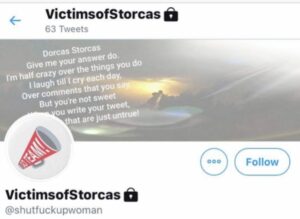
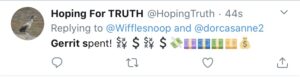
Margaret Meek Kinlochbervie
Margaret Meek Kinlochbervie. Statement of Case: Fabricated Allegations, Digital Impersonation, and Systemic Malicious Reporting 1. Executive Summary
This statement outlines a coordinated, malicious campaign originating in 2020 involving fabricated allegations of criminal impersonation, identity theft, and the submission of false reports to Police Scotland. The orchestrators of this campaign utilized digital manipulation to construct fraudulent social media profiles, misappropriated personal and sentimental assets, and engaged a former law enforcement officer to deliberately bypass standard evidentiary verification. Despite a complete absence of credible digital forensics or supporting evidence, a record of this malicious report remains unfairly retained within the Police Scotland database.
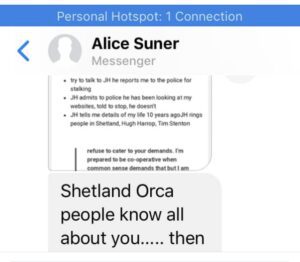
A critical turning point in demonstrating the fraudulent nature of the allegations has been reached through independent tracking. The source of multiple fraudulent profiles has been successfully identified. Crucially, one of the primary individuals operating these cloned accounts has directly admitted to their fabrication.
Despite this critical breakthrough—which provides definitive proof that the accounts were engineered by external actors to frame an innocent party—attempts to present this evidence to Police Scotland have faced severe institutional resistance, including calls being summarily terminated by handling officers.
2. Timeline of Key Parties and Core Allegations
- Accuser / Primary Actor: Margaret Meek Kinlochbervie (associated with the Facebook group NC500 The Land Weeps).
- Technical Accomplice: Richard Wright, a former police officer specializing in national security cyber forensics and internet/digital media investigations.
- Target / Affected Party: The victim of the fabricated allegations, whose identity and family assets were stolen to manufacture the dispute.
- The Core False Accusation: In 2020, Margaret Meek Kinlochbervie falsely accused Dorcas Eatch of the criminal offence of online impersonation, alleging that the target fabricated her social media profile.
3. The Digital Fabrication and Misappropriation of Assets
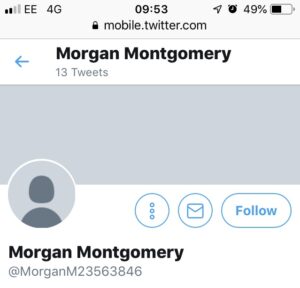
The campaign against the target relied on the deliberate manufacturing of digital evidence. Unknown bad actors constructed “sockpuppet” or fake profiles designed to mimic or link back to the target’s authentic digital footprint.
To increase the plausibility of these fake profiles and inflict emotional distress, the perpetrators engaged in the unauthorized extraction and misappropriation of intellectual property and personal assets:
- Stolen Memorial Media: The perpetrators extracted a photograph of the target’s late father directly from the RNLI In Memoriam website.
- Stolen Personal Imagery: A photograph of the target’s dog was scraped and repurposed.
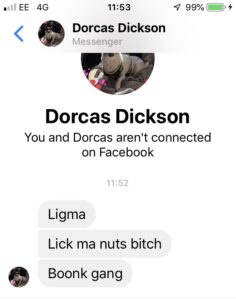
- Targeted Harassment: These stolen visual assets were deployed via fake accounts to harass members of the public and systematically manipulate third parties into filing further groundless reports with law enforcement.
The scale of the campaign involves a highly coordinated network rather than isolated online friction.
- Volume of Profiles: Over 100 anonymous profiles have been systematically generated by the core group of actors associated with the NC500 The Land Weeps network and elements within wildlife charities.
- Targeted Campaign Timing: This mass generation of fabricated evidence, fake charges, and automated malicious reporting was weaponised continuously.
- Evidentiary Aggregation: Every instance of these anonymous profiles, along with their metadata and digital footprints, is currently being actively collated into a master evidentiary ledger to prove systemic harassment.
4. The Dual-Profile Harassment Architecture The mechanism used to orchestrate the false report relied on the simultaneous creation of mirror accounts. The perpetrators constructed two distinct fraudulent profiles concurrently:
- The Cloned Target Account: A fraudulent profile mimicking the victim, populated with stolen personal photographs.
- The Cloned Accuser Account: A fraudulent profile mimicking Margaret Meek (Kinlochbervie), utilizing imagery scraped directly from her authentic online presence.
Once these accounts were established, the operators used them to engage in aggressive, public harassment of third parties. By staging a fabricated conflict between these two controlled entities, the orchestrators manufactured a false digital trail. Margaret Meek Kinlochbervie then utilized this self-generated activity as the pretext to report the real victim to Police Scotland for criminal impersonation. In reality, the victim had zero involvement in, or control over, either profile.
Despite the outward appearance of authenticity—achieved by carefully copying legitimate links, mirroring communication styles, and duplicating stolen photographs—the fraudulent accounts contain a fatal forensic flaw: the account creation metadata.
In any digital forensics investigation, the timeline of account creation is an absolute anchor of truth. An analysis of these specific profiles reveals a definitive correlation:
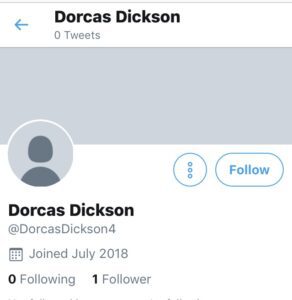
- Simultaneous Creation: The exact join date of the fraudulent profiles aligns perfectly with the date Margaret Meek Kinlochervie preferred the initial fabricated charges of impersonation.
- Post-Volume Incongruity: The anomalously low volume of historical posts stands in direct contrast to the long-established digital footprints of the real individuals they attempted to clone.
While these metadata mismatches provide immediate, objective proof of a coordinated frame, investigators failed to perform this basic verification before entering the data into the police system.
5. The “Hearsay Loop” and the Escalation to Stalking Charges.
The persistence of unverified data on law enforcement systems creates a dangerous structural vulnerability known as an evidentiary feedback loop. The persistence of unverified data on law enforcement systems creates a structural vulnerability known as an evidentiary feedback loop. Because initial fabricated reports are allowed to remain on the police database as unverified hearsay, malicious actors can weaponise this historical data. The mere existence of the previous unverified entries is used to manufacture an artificial narrative of “escalation,” which is then leveraged to push through other formal statutory charges such as stalking, despite neither complaint possessing an objective forensic foundation. Under the jurisdiction of Scots law, initiating a criminal investigation under entirely fabricated pretences, combined with targeted digital harassment, crosses into severe statutory and common-law criminality:
- Statutory False Reporting: Codified under Section 43 of the Criminal Justice and Licensing (Scotland) Act 2010, it is an offence to knowingly make a false report to the police, causing public resources and investigative time to be pointlessly expended. (Note: While Section 89(2) of the Police Act 1996 applies strictly to England & Wales, the Scottish statutory framework carries identical gravity under the 2010 Act).
- Attempting to Pervert the Course of Justice: Under Scots common law, this is a solemn offence. It is committed when an individual intentionally engages in conduct—such as manufacturing fake digital evidence or lodging a knowingly false criminal accusation—that misleads an active investigation and subverts the justice system.
- Malicious Communications and Stalking: The deployment of cloned profiles and stolen imagery to cause distress or trigger automated reporting mechanisms violates the Communications Act 2003 and sections of the Criminal Justice and Licensing (Scotland) Act 2010.
- Civil Defamation: The publication of public statements falsely accusing an individual of criminal offences meets the threshold of serious harm under the Defamation and Malicious Publication (Scotland) Act 2021, invalidating defenses of truth or honest opinion due to clear evidence of bad faith.
6. Evidentiary Failures and Investigative Omissions A central component of this grievance rests on the complete failure of both the accusers and the responding authorities to apply standard digital forensic protocols:
- Absence of IP Verification: Neither Police Scotland nor any independent investigator performed basic network analysis, metadata tracking, or IP address logging to verify the true origin of the offending accounts.
- Complicity of Technical Counsel: Despite his extensive professional background in digital media investigations and cyber forensics, Richard Wright failed to conduct any objective credibility verification on the data presented to him by Margaret Meek Kinlochbervie. Instead, he utilized his specialist knowledge to provide strategic advice on how to prefer a criminal complaint to Police Scotland, fully aware that the allegations lacked an objective evidentiary foundation.
- Demonstration of Innocence: The target actively demonstrated a total lack of involvement, establishing a clear narrative of innocence. The ease with which these claims are disproven directly supports an inference of bad faith and malice on the part of the reporting parties.
A. The Breach of Professional Credibility Standards As a highly trained cyber forensics specialist, Richard Wright possessed the exact technical expertise required to recognize a digital frame. He was fully aware that:
-
- Clone accounts can be created instantly by anyone.
- IP addresses, metadata, and creation dates must be forensically verified before attributing an account to a specific individual.
- The matching creation dates of the fake profiles constituted an immediate red flag indicating a coordinated fabrication.
B. The Intentional Guidance of Groundless Complaints
Despite this deep professional knowledge, Wright—alongside a second ex-police officer—performed zero objective validation or credibility screening on the raw assertions presented by Margaret Meek Kinlochbervie. Instead, these former officers utilized their intimate familiarity with police terminology and routing procedures to coach the accusers. They explicitly advised the group on what specific criminal charges to claim (including digital impersonation and stalking) to ensure the complaint would successfully clear initial administrative filters and be entered into the Police Scotland system.
By using their professional standing to validate a completely unverified, forensically flawed allegation, these actors actively subverted standard due process, leaving a permanent, damaging footprint on an innocent individual’s record.
7. Targeted Psychological Abuse: The Exploitation of Family Memorials and Bereavement The digital campaign orchestrated by this group—comprising grown adults in their 50s and 60s—extended far beyond simple online defamation. It crossed into a calculated pattern of psychological harassment designed to inflict maximum emotional distress by weaponising family deaths and sacred memorials.
A. The Weaponisation of Bereavement on Father’s Day
On Father’s Day 2021, the perpetrators executed a highly targeted attack using a fraudulent profile. To maximize the psychological impact, the actors systematically mined public memorial spaces to steal deeply personal assets:
- The RNLI In Memoriam Extraction: The group targeted the RNLI In Memoriam page dedicated to the victim’s late father. They extracted the last remaining photograph the victim possessed of him.
- Misappropriation of Companion Animals: The actors simultaneously stole a photograph of the victim’s late dog, Daisy.
- Coordinated Delivery: These stolen images were embedded into highly abusive messages and dispatched on Father’s Day—a date explicitly chosen to amplify grief and distress.
The victim explicitly states that this fraudulent profile, and the malicious communications sent from it, had entirely nothing to do with them.
B. Obituary Tracking and Digital Stalking Methods The group’s reliance on digital stalking is further proven by their targeting of wider family records. The actors successfully located the online obituary of the victim’s late uncle, extracted his information, and replicated the exact same harassment methodology. The mechanism the group used to discover this private family connection relies entirely on digital tracking:
- Obituary Monitoring: The victim had previously left a digital condolence message and lit a memorial candle on their uncle’s public obituary page.
- Targeted Footprint Tracing: By systematically tracking the victim’s name across public condolence boards, the network mapped out extended family structures to harvest additional targets for harassment.
8. The Malicious Intent of Mature Actors. This behavior was not the product of reckless youth or digital naivety. The individuals driving this campaign are mature adults in their 50s and 60s—including Margaret Meek Kinlochbervie within NC500 The Land Weeps and wildlife charities—who actively engage in the desecration of family memorials for amusement and targeted intimidation. Under the Communications Act 2003 and the Criminal Justice and Licensing (Scotland) Act 2010, the deliberate transmission of stolen memorial assets to cause severe distress satisfies the statutory criteria for prosecuted harassment and malicious communications.
9. Applicable Legal Framework and Potential Offences Under the jurisdiction of Scots law, initiating a criminal investigation under entirely fabricated pretences, combined with targeted digital harassment, crosses into severe statutory and common-law criminality. The conduct detailed above establishes prima facie evidence of the following offences:
A. Statutory False Reporting
- Wasting Police Time: Codified under Section 43 of the Criminal Justice and Licensing (Scotland) Act 2010, it is an offence to knowingly make a false report to the police, causing public resources and investigative time to be pointlessly expended. (Note: While Section 89(2) of the Police Act 1996 applies strictly to England & Wales, the Scottish equivalent carries identical gravity under the 2010 Act).
B. Common Law Offences
- Attempting to Pervert the Course of Justice: Under Scots common law, this is a solemn offence. It is committed when an individual intentionally engages in conduct—such as manufacturing fake digital evidence or lodging a knowingly false criminal accusation—that misleads an active investigation and subverts the justice system.
C. Digital and Civil Wrongs
- Malicious Communications: The deployment of cloned profiles and stolen imagery to cause distress or trigger automated reporting mechanisms violates the Communications Act 2003.
- Civil Defamation: The publication of public statements falsely accusing an individual of criminal offences meets the threshold of serious harm under the Defamation and Malicious Publication (Scotland) Act 2021, invalidating defenses of truth or honest opinion due to clear evidence of bad faith.
10. Severe Breaches of Due Process and Right to Reply A fundamental pillar of justice under Scots law is the right to a fair, objective, and credible investigation before criminal charges are preferred. In this instance, two severe procedural failures occurred:
- Zero Credibility Verification: Neither the initial impersonation claims nor the subsequent stalking charges were subjected to forensic digital analysis or credibility filtering by investigators.
- Denial of Right to Reply: At no point during the construction or processing of either set of charges was the target approached, interviewed, or permitted to provide an explanation or counter-evidence. The charges were advanced entirely behind closed doors based solely on the uncontested, fabricated assertions of the accusers.
11. Retention of Non-Conviction Data Despite the total absence of credible evidence, a record of the 2020 report persists on the Police Scotland internal Criminal History System (CHS). The ongoing maintenance of this data causes systemic reputational and personal harm. Because the underlying report was constructed in bad faith and lacks any forensic corroboration, its continued retention is disproportionate, inaccurate, and a breach of data protection principles under the UK GDPR and the Data Protection Act 2018.
Disclaimer: This blog post is provided exclusively for informational and educational purposes. It offers a generalized analysis of Scots law based on the provided scenario and does not constitute formal legal advice. Anyone dealing with active legal disputes, defamation issues, or the rectification of police records should formally consult a qualified solicitor registered with the Law Society of Scotland.
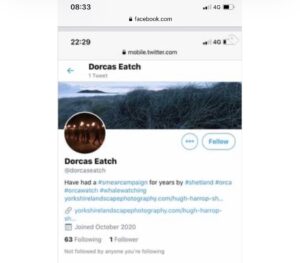
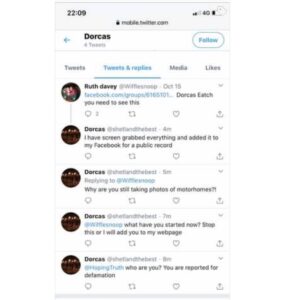

None of these people checked for credibility or investigated the source of the fake profiles before posting libellous and defamatory posts – Lee Quince, Robin Pettigrew, Trish Bangor-Jones, Gillian Stephenson, Sean Logie, Richard Wright, Ian Wilcox, Helen Iliffe-Adsett, Ruth Davey (Watts), Jon Adams Peterson, Noel Hawkins, 6 madratter accounts (is this also ex police).
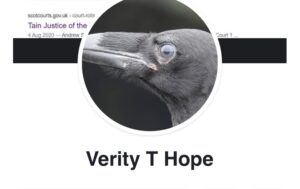
Plus previous fake profiles mentioned, firecloud, dreamonagain, John Horner, Patricia Letford, Allan Cameron, Jean Elen Hall, Kevin Laird, Jode Lane, Eileen Wild, Gillian McPherson, Steph Thomas, Sharon Jane, Sally Moore, Verity T Hope, make the call, Tommy Anderson, Jack Matheson, Megan Scott plus lots of other fake profiles, Ross Dakers, Stephen MacKay etc Sheil Motley, Steve Birrell, Amber Davis, Daniel Grey, Rhianne Kohnston, Alice Suner, Geoff Starkie, ullapool Seasavers, Ullapoolqueen, Ullapool craic, Catherine Mclean, Tariq Sheikh, Dierdre Henderson, Echlin Wright, Barbara Jones, Christine Grace, Rich Gunn, Victor Roney, Trevor McKay, visitandtravel, Margaret Meek Kinlochbervie.
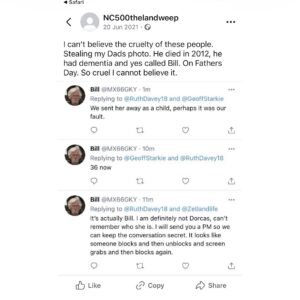
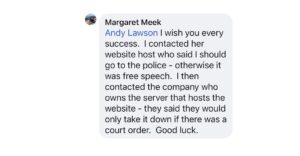
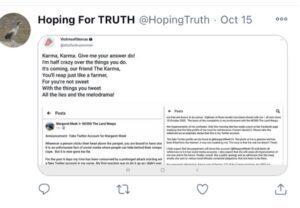
Fake profiles nothing to do with me.

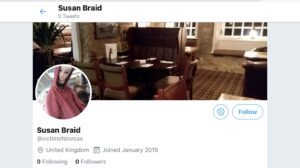
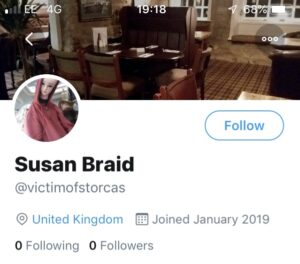

All by people in the group.



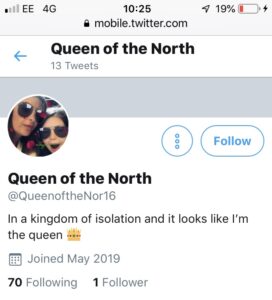
And there’s more