The Weaponisation of Perception: How the Current Legal Framework Invites Vexatious Allegations
The Weaponisation of Perception. In the modern landscape of criminal justice, a profound shift has occurred in how allegations are reported, recorded, and prosecuted. At the center of this shift is the concept of perception-based reporting—a framework originally designed to ensure victim voices were heard, but one that increasingly risks being weaponised in interpersonal disputes. When the standard for recording an offence relies entirely on the subjective perception of the accuser, the legal system inadvertently opens the door to vexatious litigation, leaving innocent individuals caught in a web of unverified charges. These are also recorded as single separate incidents not looked at for patterns or repetitive malicious use by bad faith actors. Not are there any restrictions or end time limits.
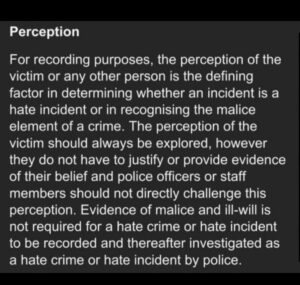
Traditionally, criminal charges require a robust foundation of objective evidence. However, modern guidance allows allegations to be pushed forward based almost entirely on the accuser’s stated perception.
Objective Evidence vs. Subjective Perception
To understand how the current framework of The Weaponisation of Perception can be exploited, it is essential to analyze the stark legal contrast between objective evidence and subjective perception. The integrity of a fair trial relies heavily on balancing these two concepts, yet modern recording practices have heavily skewed the scales.
- Subjective Perception: This refers entirely to an individual’s internal, emotional, or psychological reaction to an event. In many modern policing guidelines, if a complainant states they felt “fear, alarm, or distress,” that statement is often treated as immediate grounds to log a criminal report. Because perception is entirely internal, it cannot be independently verified; it relies completely on the credibility of the speaker. If a person claims that a mundane, everyday action—such as driving to a medical center for cancer appointments or going to a supermarket—caused them “fear, alarm, or distress,” the system is designed to log the incident based on that narrative
- Objective Evidence: This consists of verifiable, external facts that exist independently of anyone’s feelings or interpretations. Examples include CCTV footage, GPS tracking, medical records, third-party witness testimony, or digital footprints. Objective evidence either corroborates or disproves a claim.
When a legal system prioritises subjective perception over objective evidence at the reporting stage, everyday, verifiable acts—like driving to a medical centre for cancer appointments or entering a supermarket—can be recontextualised as criminal behaviour simply because someone claims it made them uncomfortable. That’s The Weaponisation of Perception.
A clear example of how these ordinary daily movements can be systemically twisted into a multi-year campaign of harassment 2017-2026 is documented in the Orca Watch Gangstalking Timeline, illustrating how a target’s medical routines and errands are tracked and weaponised through the legal system.
The Role of COPFS: Rubber-Stamping vs. Evidentiary Review
Once the police compile a report based on an accuser’s subjective perception, the file is passed to the Crown Office and Procurator Fiscal Service (COPFS). As the sole public prosecution body in Scotland, the Procurator Fiscal is legally obligated to review these files to determine if a case should proceed to court.
However, structural flaws within the pipeline severely undermine this review process:
- The “Sufficiency of Evidence” Illusion: Under Scottish law, the Fiscal looks for a “sufficiency of evidence”—meaning two corroborating sources. In perception-based cases, if two people coordinate a similar subjective narrative, or if an individual claims multiple instances of feeling “alarmed,” the system can interpret this as a sufficient legal basis to prosecute, regardless of whether any objective, physical evidence exists.
- Bypassing the Accused’s Reality: Because the initial police report is often sent to the Fiscal without officers ever formally interviewing the accused or gathering their counter-evidence, the Procurator Fiscal receives a heavily one-sided dossier. The critical context—such as verified timelines for medical appointments—is frequently missing from the initial file as in my case from 2017-2026.
- The “Recipe for a Stitch-Up”: Because the barrier to entry is so low, individuals with personal grudges can easily look up specific statutory language (such as “fear, alarm, and distress”) on police websites to construct a complaint that satisfies the technical requirements for a criminal referral.
- The Public Interest Shield: While the COPFS Prosecution Code explicitly states that prosecutions must be in the “public interest,” the fear of failing to act on reported distress means that minor, highly localized personal disputes are frequently pushed through the system rather than being filtered out as vexatious litigations
The Accountability Vacuum for Vexatious Reportees
Perhaps the most damaging aspect of the current legal landscape is the near-total lack of accountability for individuals who abuse perception-based reporting. The system provides powerful tools for the accuser, but offers almost no protection or recourse for the falsely accused.
- Immunity Through “Good Faith” Assumptions: Because the system is built on the rule that reports must be accepted based on the victim’s perception, it is incredibly difficult to penalize someone for a false report. An accuser can claim they sincerely felt threatened by an ordinary action, shielding themselves from malicious prosecution or wasting police time charges by hiding behind their subjective state of mind.
- Ignored Counter-Complaints: Individuals caught in these cycles frequently report a “pick-and-mix” approach to policing. While the accuser’s subjective claims are fast-tracked, the accused’s objective proof of systemic fabrication, harassment, or patterns of behavior spanning years are routinely ignored or glossed over. The system lacks a formal, impartial mechanism to evaluate cross-complaints effectively.
- The Cost of Vindictiveness: Vexatious actors are well aware that the process itself is a form of punishment. They face no financial or legal penalties for filing unverified reports, while the targeted individual is left to carry the immense emotional, physical, and financial burden of defending their innocence. In my case from 2017-2026 and beyond.
Police Blacklisting and the “Unreasonable Actions” Policy
When a target tries to fight back against a wave of fabricated claims, they often hit a wall known as institutional blacklisting. Modern policing bodies and administrative frameworks like the Scottish Police Authority (SPA) utilize specific policies designed to handle what they term “persistent or unreasonable complainers”.
While intended to save public resources, this system can be weaponised against victims of vexatious litigation in two profound ways:
- The Silent Blacklist: If an individual submits multiple complaints regarding fabricated charges, systemic bias, or the failure of officers to review objective CCTV evidence, the system can internalise these contacts as “unreasonable persistence”. Instead of investigating the ongoing fraud, authorities can effectively blacklist the individual, lowering the priority of their communications or closing their files without a response.
- The Imbalance of Recourse: While an accuser can freely file countless subjective complaints that are automatically pushed through the system, the target’s attempt to lodge counter-complaints or present proofs of a 10-year fabrication campaign are glossed over. The blacklisting mechanism ensures that the person with the lower structural status or fewer resources is systematically ignored, effectively transforming the police force into a private enforcement arm for the initial vexatious actor. It becomes a legalised witch hunt. This is Police Scotland.
The Reality of Weaponised Offence-Taking
This issue is not merely theoretical; it has been acknowledged at the highest levels of law enforcement. In a notable report published by the Daily Record, it was highlighted that senior figures within Police Scotland warned of an unintended consequence of modern reporting systems. The force observed:
- “What was never anticipated was the current context of large-scale weaponisation of offence-taking and divisive culture wars, often playing out over social media.”
This admission confirms that the legal apparatus is frequently being used as a tool for private vendettas. When structural resources are poured into pursuing subjective, non-violent claims while institutional blacklisting silences legitimate counter-complaints, it abandons the core tenets of fairness and impartiality.
This admission confirms that the legal apparatus is frequently being used as a tool for private vendettas. When “pick-and-mix” policing occurs, structural resources are poured into pursuing subjective, non-violent, or non-hate claims, while cross-complaints or proofs of systemic fabrication over long periods are routinely ignored.
The Chilling Effect on Due Process
When the legal system allows itself to be used as a private enforcement arm for vexatious actors, it abandons the core tenets of fairness and impartiality.
- The Process is the Punishment: Even if an unfounded charge is eventually dropped or rejected by prosecutors, the emotional, physical, and financial toll of being dragged into the legal system is immense. For individuals dealing with serious illnesses, this strain is amplified.
- The Rejection of Resolution: Vexatious litigators routinely refuse out-of-court resolutions or mediation, preferring instead to utilize the mechanics of the state to perpetuate ongoing harassment against their targets as in my case from 2017-2026 to engineer imprisonment.
- The Burden of Disproof: For an individual on their own, proving a negative is exceptionally difficult. Without wearing a bodycam 24/7, a person carrying out ordinary daily tasks has no way to defend against a fabricated account other than relying on public CCTV or records that the police may choose not to pull.
Looking Ahead at The Weaponisation of Perception
The integrity of our justice system relies on an objective search for the truth, not the blind acceptance of weaponised narratives. As long as policing policies and prosecutorial reviews prioritize subjective perception over rigorous evidence gathering—and use blacklisting policies to ignore those trying to defend themselves—the system will remain a dangerous tool for those looking to turn everyday legal movements into criminal acts. That is The Weaponisation of Perception.
After years of experiencing all of this I can vouch there is no help from anyone and no way out, you’re on your own just being battered more and more every year.
If you enjoyed this please think about buying me a coffee as every trial costs me £30,000 from my pension pot until I am destitute. Thanks.
Disclaimer: The information provided in this blog post is for general informational and commentary purposes only and does not constitute formal legal advice.
Transparency Note: This blog post was co-created with the assistance of artificial intelligence. The core concepts, structuring, and final review were handled by a human author to ensure accuracy and value, while the prose was drafted with AI support.
The Weaponisation of Perception